
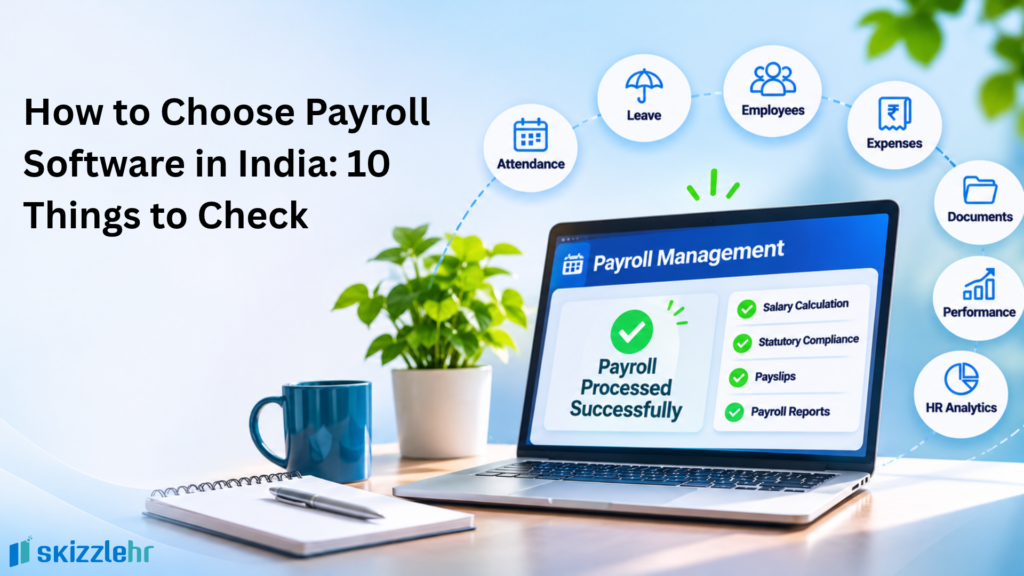
Introduction
Payroll is one of the most critical functions in any organisation. Employees expect their salaries to be accurate and paid on time, while HR teams need to manage attendance, deductions, statutory compliance, payslips, reimbursements, and payroll records without unnecessary manual effort.
As businesses grow, managing payroll through spreadsheets or disconnected systems can become increasingly difficult. This is where payroll software India businesses use can make a significant difference. The right solution can automate repetitive calculations, reduce errors, support compliance, and give HR teams better visibility into payroll processing.
However, choosing payroll software in India is not simply about selecting the platform with the longest feature list. The software should fit your organisation’s workforce, payroll structure, compliance requirements, and future growth plans.
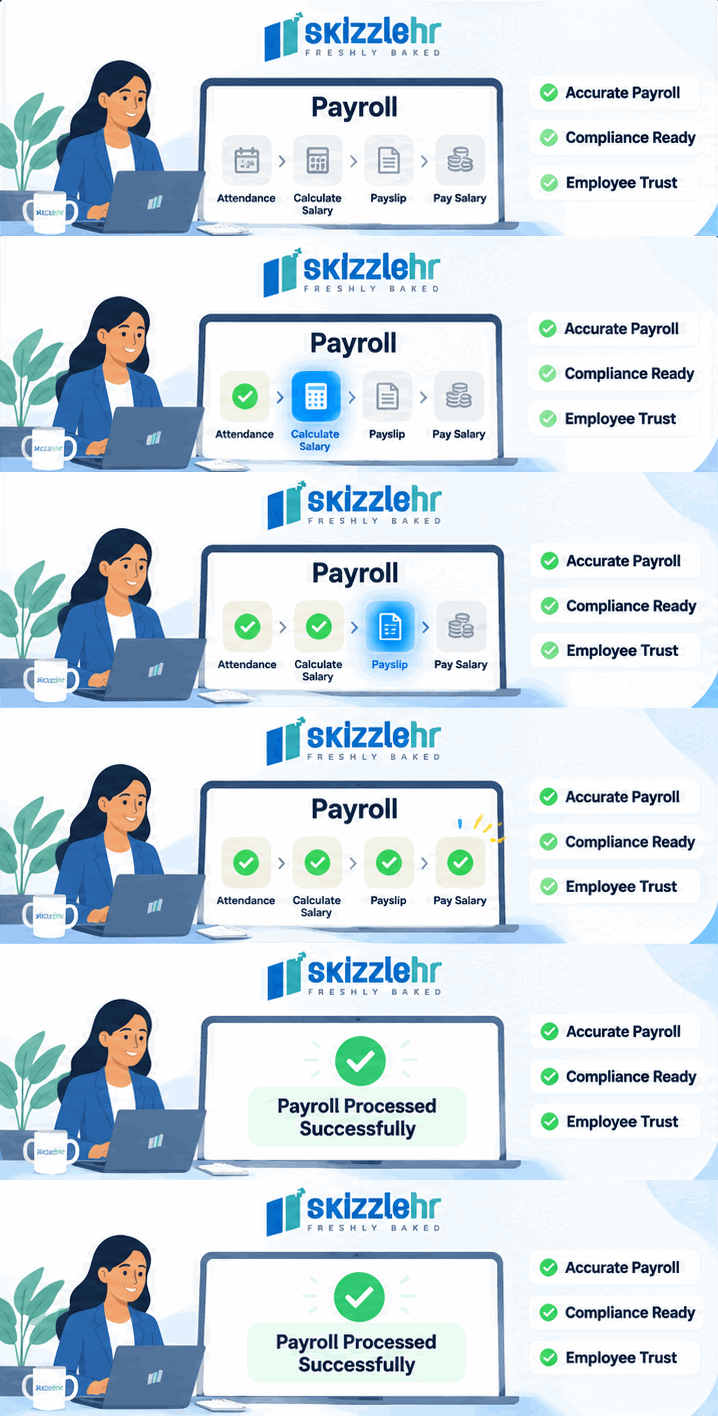
If you are evaluating payroll management software, here are 10 important things to check before making your decision.
1. Check Payroll Automation Capabilities
Payroll automation should be one of the first things you evaluate.
A good payroll platform should reduce repetitive manual work involved in salary calculations, deductions, attendance inputs, leave adjustments, and payslip generation. Instead of repeatedly collecting data from different sources, HR teams should be able to process payroll using information already available within the system.
Look for features such as:
- Automated salary calculations
- Attendance and leave integration
- Automated deductions
- Variable pay management
- Payslip generation
- Full and final settlement support
- Payroll reports
- Payroll processing workflows
The objective of payroll automation is not simply to make payroll faster. It should also make the process more consistent and less dependent on manual calculations.
2. Evaluate Statutory Compliance Features
Payroll in India involves several statutory components, making compliance an essential consideration when choosing payroll software.
The system should support relevant statutory calculations and payroll requirements, including components such as:
- Provident Fund (PF)
- Employee State Insurance (ESI)
- Professional Tax (PT)
- Tax Deducted at Source (TDS)
- Labour Welfare Fund (LWF)
- Statutory reports and challans
- Form 16
- Other applicable payroll records
When comparing online payroll software, ask how frequently the provider updates its compliance functionality when regulations or requirements change. Choosing reliable statutory compliance software can help HR teams stay updated with applicable requirements, manage statutory deductions, and maintain accurate payroll records.
A payroll platform should help HR teams manage compliance systematically rather than simply providing a digital version of a spreadsheet.
3. Look for Attendance and Leave Integration
Payroll does not operate independently from attendance and leave management.
An employee’s working days, absences, leave, overtime, and other attendance-related information can affect salary calculations. If HR teams have to manually transfer this information into payroll every month, there is more room for discrepancies.
Payroll software in India should ideally connect payroll with attendance and leave data.
This can help organizations:
- Reduce duplicate data entry
- Calculate salary based on relevant attendance information
- Account for leave adjustments
- Reduce payroll discrepancies
- Speed up monthly payroll processing
Integrated systems are particularly useful for organizations with multiple locations, shifts, remote employees, or larger workforces.
4. Review the Payroll Features You Actually Need
More features do not automatically mean better software.
Before comparing vendors, create a list of your actual payroll requirements. For example, a growing company may need employee salary structures, deductions, reimbursements, loans, advances, statutory calculations, payslips, reports, and full and final settlement.
A useful evaluation checklist includes:
| Payroll Requirement | What to Check |
| Salary processing | Can the system automate salary calculations? |
| Deductions | Can statutory and other deductions be configured? |
| Payslips | Can employees access digital payslips? |
| Variable pay | Can bonuses and other variable components be managed? |
| Loans & advances | Can deductions be reflected in payroll? |
| Full & final settlement | Is F&F supported? |
| Reports | Are payroll reports available for HR and finance? |
| Compliance | Are Indian statutory requirements supported? |
| Employee access | Can employees access their payroll information? |
This prevents your evaluation from being driven by features that your organisation may never use.
5. Check Employee Self-Service Capabilities
Modern payroll management should not require HR teams to answer every employee query manually.
Employee self-service allows employees to access relevant information themselves, such as payslips, salary details, documents, and other HR information depending on the system.
This can reduce repetitive HR requests and give employees greater visibility into their own information.
When evaluating online payroll software, check whether the employee portal is easy to use on both desktop and mobile devices. A technically powerful system can still create problems if employees struggle to find basic information.
6. Assess Ease of Use
Payroll is a recurring process. HR teams may use the system every month—or every day—so usability matters.
During a product demonstration, don’t only look at the dashboard. Ask the vendor to show you the actual payroll processing workflow.
Consider questions such as:
- How many steps are required to process payroll?
- Can HR quickly identify errors or missing information?
- Are payroll reports easy to generate?
- Can administrators make changes without extensive technical knowledge?
- Is employee information easy to find?
- Can employees navigate the system without extensive training?
The right payroll platform should simplify payroll processing rather than introduce another complicated system for HR teams to manage.
7. Evaluate Reporting and Payroll Analytics
Payroll data can provide valuable insights into workforce costs and salary trends.
A payroll management system should offer useful reports that help HR teams understand payroll-related information without manually combining multiple spreadsheets.
Depending on your requirements, look for reporting around:
- Salary costs
- Department-wise payroll
- Employee deductions
- Statutory contributions
- Attendance-related adjustments
- Reimbursements
- Loans and advances
- Payroll history
Better reporting can also support workforce planning and help management make more informed decisions about employee costs.
8. Check Security and Data Protection
Payroll systems handle highly sensitive employee information, including salary details, bank-related information, tax information, and personal employee data.
Security should therefore be part of your software evaluation—not an afterthought.
Ask vendors about:
- Role-based access
- Administrator permissions
- Data security measures
- Authentication controls
- Audit trails
- Backup processes
- Employee access controls
You should also consider whether different users can be given different levels of access. For example, an employee should not automatically have access to payroll information belonging to another employee.
9. Consider Scalability and Integration
The payroll system you choose today should be able to support your organisation as it grows.
A small business may initially have a relatively straightforward payroll structure. As the organisation expands, it may add new locations, departments, shifts, employee categories, salary structures, or additional HR processes.
Therefore, when looking for payroll software for small businesses, don’t evaluate only your current employee count. Consider where your organisation could be in the next few years.
It is also useful to check whether payroll can work alongside other HR functions such as:
- Employee management
- Attendance
- Leave
- Expense management
- Performance management
- Documents
- Employee self-service
- HR analytics
An integrated HRMS can reduce the need to maintain multiple disconnected systems.
10. Compare Pricing, Support and Implementation
Cost is important, but the cheapest payroll software is not necessarily the most cost-effective option.
When comparing pricing, consider the complete cost of ownership. Check whether implementation, employee onboarding, support, integrations, additional modules, or other services involve separate costs.
Also evaluate the support provided by the vendor.
Ask:
- What support channels are available?
- How quickly are support queries addressed?
- Is implementation assistance provided?
- Is employee or administrator training available?
- How are compliance updates communicated?
- What happens when your payroll team encounters an issue during payroll processing?
A reliable support system can be particularly important during monthly payroll cycles when delays or errors can directly affect employees.
Quick Checklist: What to Look for in Payroll Software
Before making your final decision, use this checklist:
Payroll Functionality
☐ Automated salary calculations
☐ Automated deductions
☐ Payslip generation
☐ Variable pay management
☐ Loans and advances
☐ Full and final settlement
☐ Payroll reports
Compliance
☐ PF support
☐ ESI support
☐ PT support
☐ TDS support
☐ LWF support
☐ Form 16
☐ Statutory reports and challans
HR Integration
☐ Attendance integration
☐ Leave integration
☐ Employee database
☐ Employee self-service
☐ Expense management
☐ HR analytics
Technology & Usability
☐ Easy-to-use interface
☐ Mobile accessibility
☐ Role-based access
☐ Data security
☐ Reporting and analytics
☐ Scalability
☐ Reliable customer support
Tips for Choosing the Right Payroll Software
Before signing up for a payroll platform, keep these practical tips in mind:
1. Define your requirements first.
List the payroll problems your HR team currently faces before comparing vendors.
2. Don’t choose based only on the feature list.
A platform with hundreds of features is not necessarily the right solution if the important workflows are difficult to use.
3. Request a live demo.
Ask the vendor to demonstrate your actual payroll workflow rather than showing only standard product screens.
4. Test integration between HR functions.
Payroll should ideally work with attendance, leave, employee data, expenses, and other relevant HR processes.
5. Think beyond today’s requirements.
Choose a platform that can support changes in your workforce, payroll structures, and HR operations as your business grows.
6. Evaluate the employee experience.
Payroll affects employees directly, so payslips, salary information, and self-service access should be simple and accessible.
Where SkizzleHR Fits In
Choosing payroll software is ultimately about finding a system that makes payroll more accurate, efficient, and manageable while fitting into your broader HR operations.
SkizzleHR is an AI-powered HRMS designed to bring payroll and other essential HR processes together on a single platform. Its payroll capabilities support salary calculations, deductions, payslips, statutory components, payroll reports, and other recurring payroll activities.
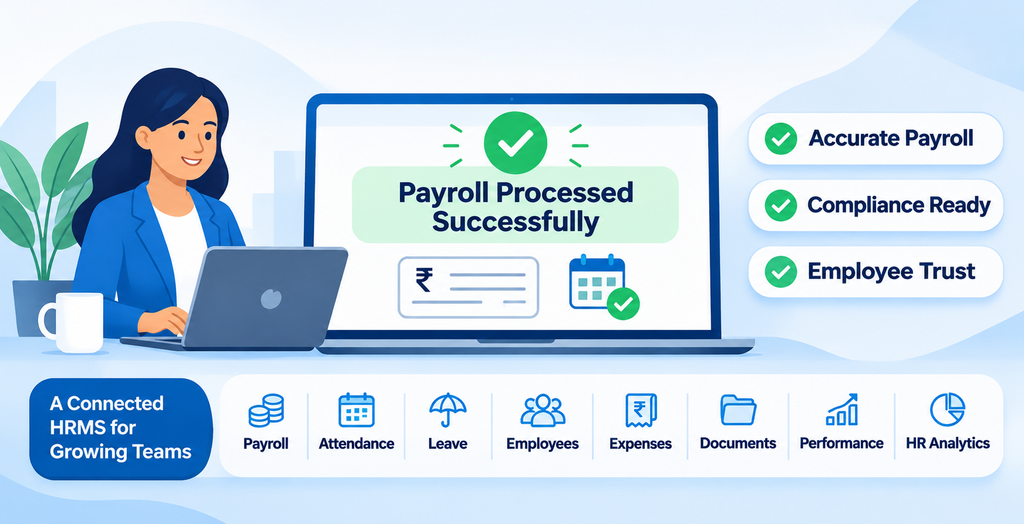
Instead of treating payroll as an isolated function, SkizzleHR connects it with areas such as attendance, leave, employee management, expenses, documents, performance, and HR analytics. This gives HR teams a more connected view of employee information and reduces the need to manage related processes across separate systems.
For organisations evaluating the best payroll software India has to offer, the right approach is to compare platforms against your actual workflows, compliance requirements, employee experience, integration needs, and growth plans.
The best solution is not necessarily the one with the most features. It is the one that helps HR teams process payroll accurately, reduce repetitive work, maintain compliance, and manage payroll with greater confidence.
Frequently Asked Questions
1. What is payroll software?
Payroll software is a digital system that helps organisations calculate employee salaries, apply deductions, manage payroll records, generate payslips, and support payroll-related compliance.
2. What should businesses look for in payroll software in India?
Businesses should evaluate salary calculation, statutory compliance support, attendance and leave integration, payslip generation, reporting, data security, employee self-service, scalability, pricing, and customer support.
3. Is online payroll software suitable for small businesses?
Yes. Online payroll software can help small businesses reduce manual calculations, organise employee payroll information, generate payslips, and manage recurring payroll tasks. The selected system should match the organisation’s size and requirements.
4. How does payroll software help with statutory compliance in India?
Depending on its features and configuration, payroll software can support calculations and records for applicable components such as PF, ESI, Professional Tax, TDS, and Labour Welfare Fund. Organisations should verify current requirements and the provider’s update process.
5. Can payroll software integrate with attendance and leave management?
Many payroll systems can use attendance and leave data to support salary calculations and adjustments. Check whether the integration fits your attendance policies, shift structures, and approval workflows.
6. What is the difference between payroll software and a payroll management system?
The terms are often used interchangeably. Both generally refer to software used to manage salary processing, deductions, payslips, payroll records, and related workflows. The actual capabilities vary by provider.
Final Takeaway
Payroll is too important to rely on complicated manual processes. The right payroll software India solution can help organisations automate payroll processing, improve accuracy, simplify compliance, and give employees easier access to their payroll information.
Before choosing a platform, evaluate its automation capabilities, compliance support, payroll features, integrations, security, usability, reporting, scalability, pricing, and customer support.
Use the checklist above during your evaluation, request a live demo, and make sure the software fits both your current payroll requirements and your future HR needs.
When these factors come together, you are more likely to identify the right payroll management platform for your organisation.